France’s schools, prisoners of the State
French schools are falling behind because the State decides everything without being responsible for anything. Switzerland and Estonia show another way.
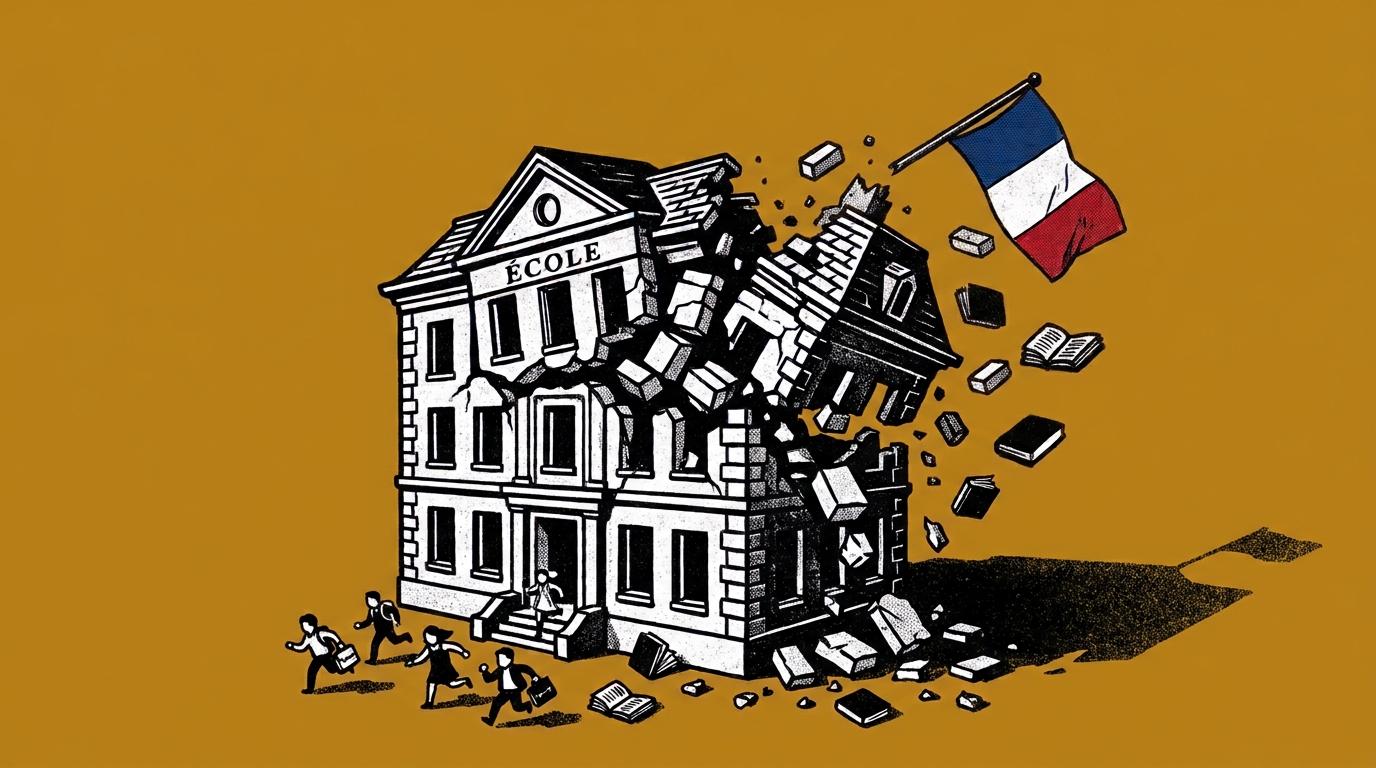
Few subjects have been measured, compared and discussed as extensively as the decline of French schools. Few countries have such a comprehensive statistical record. The diagnosis of falling educational standards is well known, repeated and almost ritualistic. Why, then, does the problem seem impossible to solve in a country that places education so high in its republican identity?
The French education system is failing on every front
Let us start with operational gaps. According to the latest available figures, nearly 10% of scheduled teaching hours were not delivered in state secondary schools, largely because absent teachers are rarely replaced, particularly when their absence is short.
Recruitment is also failing to keep pace with demand in subjects facing teacher shortages. In 2025, only 74.4% of the mathematics teaching jobs advertised through the CAPES recruitment examination were filled. Schools make up the shortfall with contract teachers, who account for around 10% of teachers in state secondary education. The profession itself is becoming less attractive: after 15 years of service, a French secondary school teacher earns approximately $53,000 a year, below the OECD average.
The most serious problem, however, is educational performance. According to a DEPP comparison of pupils' mathematics skills between 1987 and 2017, only around 7% of pupils in the final year of primary school in 2017 reached the median level recorded in 1987. More than half performed below the threshold of the weakest 10% of pupils in 1987. By the age of 15, French pupils had fallen to 33rd place in the 2025 PISA mathematics rankings, scoring 458 points against the OECD average of 463. They also scored below the average in reading (456 against 461) and only marginally above it in science (483 against 482). Falling standards affect both the weakest and the strongest pupils. In France, academic achievement also remains heavily dependent on social background.
A state that decides everything but answers for nothing
The explanation for this failure is straightforward: French education is run by a state that decides everything without being held accountable, imposing the same framework on everyone. Those who determine the nation's educational future face no consequences for their decisions. A single mistake can affect millions of children without costing its authors their positions, careers or reputations.
Decisions cascade into failure, without accountability. The chain of responsibility leads nowhere. Permanent teachers are state employees: their careers progress according to seniority, inspections are rare, and dismissal is exceptional. Headteachers cannot choose their own staff. Transfer rules often keep experienced teachers away from the classrooms that need them most. Working conditions are negotiated with public-sector unions, while families have no comparable influence.
The single national pay scale prevents schools from paying the best teachers more, or rewarding those willing to work in difficult schools. Apart from a few allowances, seniority is the only factor determining career progression. The profession is least attractive precisely where it should be most attractive.
Every attempt to bring decision-making closer to the classroom has met the same resistance. In December 2011, almost all teachers' unions called a strike against proposals to allow headteachers to evaluate teachers. In 2015, organisations representing more than 80% of secondary school teachers rejected the middle-school reform at the Higher Council for Education, which was based on greater school autonomy. Recruiting teachers according to individual profiles remains a red line for unions. In the name of equality and out of fear of arbitrary decisions, they defend a system of employment protections that serves their members. Families, scattered and poorly represented, have nobody to defend their interests. This is why the problem seems impossible to solve. Pupils and the nation are left to pay the price.
Uniformity prevents schools from adapting
When education is entrusted to the state, uniformity is its natural tendency. The single middle-school model and school catchment areas impose the same framework on everyone, at the same age and within the same geographical boundaries. They eliminate alternative pathways without offering anything in their place that takes pupils' different abilities and needs into account. This rigidity makes schools unable to adapt to technological disruption, particularly artificial intelligence, which is set to transform educational practices. As Frédéric Bastiat wrote:
“I find it difficult to understand why those who demand a Unitary Education run by the state do not also demand a Unitary Press run by the state. The press is also a form of education. […] Either the state is infallible, in which case we could do no better than entrust it with the entire realm of human thought; or it is not, in which case entrusting education to it is no more rational than entrusting it with the press.”
In a system where nobody is held accountable and a principle of enforced egalitarianism prevails, criticising the institution exposes people to moral suspicion. Its functioning thus becomes unquestionable and, consequently, impossible to reform.
It is hardly surprising that many families who can afford to do so leave state schools for private institutions. Everyone else remains trapped in the public system.
Responsibility must lie as close as possible to the pupil
A healthy education system rests on one essential principle: whoever makes decisions about a child's educational future must answer to that child's family and be judged on publicly available results.
Several principles follow.
The state sets the knowledge and skills every pupil must acquire at each stage. It verifies them through demanding national examinations, publishes results for each school and ensures fair funding across regions. It does not dictate teaching methods, timetables or staffing. A state that manages everything answers for nothing. A state that measures performance answers for the standards it sets, while those it assesses are responsible for everything else.
Headteachers should choose their own staff: they should recruit, evaluate and have the power not to renew contracts. They should set salaries, subject to a national minimum, and be able to pay more in subjects where candidates are scarce, such as mathematics. As in most Swiss cantons, teachers would no longer be civil servants but employed under contracts. Their employer would be the school or a network of schools, rather than the state. Schools would organise their teaching freely, deciding on teaching hours, ability groups, remedial classes, textbooks and methods. They could experiment because a failed initiative would affect only a few classes for one year, allowing mistakes to be corrected.
School catchment areas, which determine which school pupils must attend based on their home address, should be abolished. Public funding should follow the pupil in the form of an education voucher, which families could use at the school of their choice, whether state-run or private, provided that the institution enters its pupils for national examinations and publishes the results. Schools would therefore have an incentive to improve their provision and performance to attract families.
The equality that matters is ensuring that everyone has access to a worthwhile future, not forcing everyone into the same framework at the same age. The single middle-school model should give way to gradual specialisation: a solid common foundation followed by differentiated levels according to academic performance, with opportunities to move in either direction. Businesses should become full partners in education through dual vocational training. Employers would help design and finance part of the training, while the qualifications obtained would allow students to pursue further education. No pathway should become a dead end.
Switzerland and Estonia show that it works
No country applies all these principles in full, but two come close and have achieved undeniable results.
Switzerland is the first example. It does not run its school system from Bern. Each of the 26 cantons, together with its municipalities, organises and finances education and sets the employment conditions for its own teachers. At around the age of 12, pupils are divided into different academic levels according to their performance.
The cornerstone of the system comes at the end of compulsory schooling. Two out of every three young people choose vocational education. Most opt for dual vocational training, which is available in hundreds of occupations: they spend several days a week working in a company and the remaining time at vocational school. This pathway is not a dead end. A vocational baccalaureate provides access to universities of applied sciences. Eight years after obtaining their vocational qualifications, more than one in three apprentices has entered higher education.
In 2025, youth unemployment stood at 8.8% in Switzerland, compared with 19.7% in France. This success has not come at the expense of academic excellence. Despite an overall decline in scores, Switzerland is outperformed in OECD mathematics rankings only by Japan, South Korea and Estonia. A 15-year-old Swiss pupil is almost two years ahead of a French pupil. The proportion of pupils reaching the two highest performance levels is three times higher than in France. Finally, the fact that Switzerland trains most of its young people through apprenticeships has not prevented it from also having the highest number of AI researchers and developers per capita in the world.
The second example is Estonia. In 1991, this small Baltic country emerged from the Soviet Union with a standard of living far below France's. It made a deliberate choice: to place most decision-making power in the hands of schools and teachers. The school's owner, usually the municipality, appoints the headteacher, who is then responsible for recruitment. The state sets only a minimum salary; actual teacher pay and salary progression are determined by the headteacher. One state secondary school in Tallinn, for example, has announced that it pays its mathematics teachers around €500 more per month after tax than other teachers. Each school develops its own curriculum within the national framework. Teachers choose the content, methods and assessments. According to the 2022 PISA survey, no other country gives its teachers as much freedom over curricula. In return, the state monitors learning outcomes through national examinations at the end of middle and secondary school.
According to PISA assessments, Estonia has ranked first in Europe in science and mathematics for four consecutive assessment cycles and is among the ten highest-performing education systems in every subject.
What Bastiat's dilemma reveals
Bastiat posed this dilemma in 1848: either the state is infallible or it is not. French education has answered that question for decades. The state has repeatedly made mistakes, and each one has cost an entire generation an education that cannot be repeated. The problem is not that the state is less competent than another institution. It is that the state is the only actor making the major decisions in a system where it never has to answer for its choices.
Switzerland and Estonia do not have better ministers. They have placed decision-making where its consequences are felt, and reduced mistakes to what they should be: failed experiments affecting a few classrooms, with clearly defined responsibilities, rather than a predetermined fate for an entire generation. France, by contrast, has acted as though the state were infallible, and children have paid the price.
- Frédéric Bastiat, ‘Justice et fraternité’, Journal des économistes, June 15th 1848. ↩
Similar topics


Share to: