The EU’s future plans go against freedom: the Letta and Draghi reports
EU leaders keep proposing statist measures that will worsen the bloc's economy.
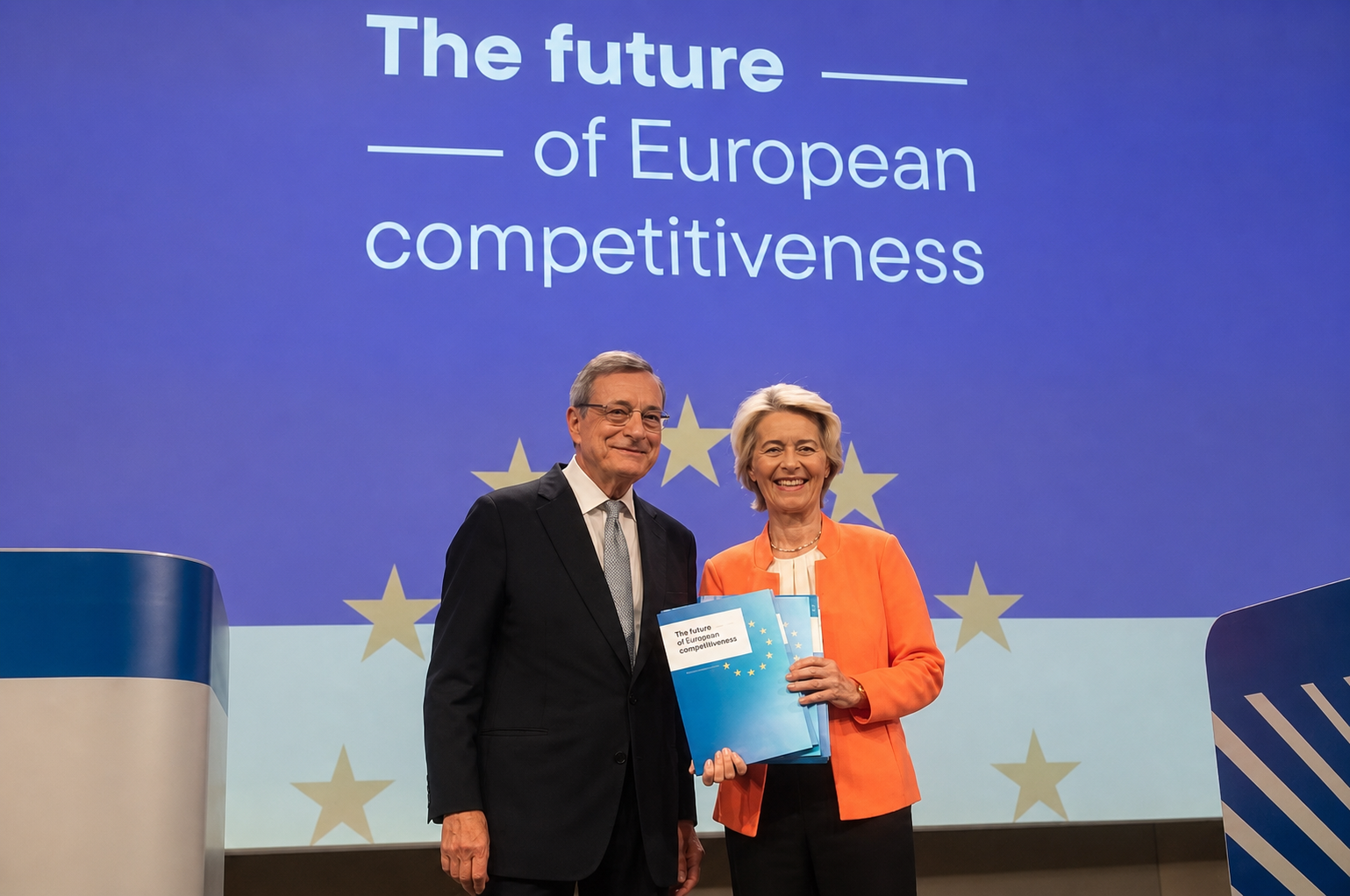
The Letta and the Draghi reports are a good place to start if you want to understand the European Union’s idea of its future.
They have often been mentioned by the EU chiefs and pro-EU leaders; less so when it became clear that these reports had, as one reviewer wrote, “overloaded messages and limited impact”. Nevertheless, they still represent the EU’s official policy direction and therefore deserve careful scrutiny.
Controversial and counterproductive remedies
The Letta Report ("Much More Than a Market", Apr. 2024) and the Draghi Report ("The Future of European Competitiveness", Sept. 2024) both make uncontroversial diagnoses: starved of competitiveness and innovation, Europe is falling rapidly behind the United States and China. What is controversial, however, is their prescribed remedy. Rather than halting the mismanagement of public funds, calling out overbearing statist intervention, or relieving the fiscal pressure on European taxpayers, both reports accept this current regime as a given. There is virtually no recognition that state overreach is precisely the primary disease afflicting the continent.
The proposed solutions double-down on past mistakes: financial centralization, loose monetary policy, fiscal harmonization, and regulatory consolidation. Instead of admitting why the EU strayed from the original idea of four freedoms - which would require a return to freer markets, deregulation, and subsidiarity - the reports propose a massive expansion of EU power. This knee-jerk reaction is typical of any state bureaucracy seeking to justify its own “need” to grow. To be sure, both reports include a few welcome suggestions, such as removing obstacles to cross-border capital flows and streamlining investment across member states. Yet these positive elements are heavily overshadowed by the statist ambitions.
Both reports also endorse increased protectionism. Restricting free trade with lower-cost, high-quality producers in China invariably harms European consumers by driving up the cost of foreign goods. While tariffs may temporarily shield select domestic industries, their long-term efficacy is doubtful, as the current plight of Europe’s automotive sector demonstrates. The EU has imposed significant costs on European industries for mainly ideological reasons (most notably with the “Green Deal”) and through excessive regulation. Now the EU’s anti-Russian energy policy is dealing some of them their final blow, which is something the Draghi and Letta reports do not meaningfully address.
Spend, spend, spend
Rather than scaling back interventionism, the reports advocate turbocharging the ECB’s inflationary policy through a massive public spending program: €750 to €800 billion in "joint" public investment targeting energy, defense, AI, infrastructure, and industrial competitiveness. This typical neo-Keynesian strategy seeks to artificially stimulate European economies at the expense of market-driven allocation.
By pushing for this plan at the EU level under the banner of "mutualization," the idea is to bypass national debt constraints and avoid spiking sovereign interest rates. Yet an economic rationale for additional state-directed investment of this magnitude is difficult to justify, given that Europe's overall investment as a share of GDP is higher than that of the United States. Simply funnelling more taxpayer capital through central planning will not bridge the innovation gap; even more so if done at EU level, layers away from the actual recipients.
The reports also recommend for EU to get its “new own resources”, complaining its budget is too small (Draghi, p.64). In other words, they want new EU-level taxes, such as carbon border charges, digital taxes, or levies on strategic imports – and perhaps even VAT, as the Letta plan boldly states (p111). Both Draghi and Letta argue that the Union can no longer depend solely on national contributions: it requires its own stable revenue streams - European taxes collected directly to fund EU-wide policies. It is simply too tempting…
The capture of private savings
Perhaps the most troubling element is the Letta report's focus on Europe’s €3 trillion pool of household savings, which EU technocrats view as "underutilized." As Draghi lamented in 2024, European private savings are largely held in bank deposits rather than equity markets, prompting calls for a Capital Markets Union (CMU). Letta went further, proposing a "Savings and Investments Union" designed explicitly to retain and redirect these funds.
In a striking admission, Letta noted that the CMU's objective was to enable European leaders to "pull trillions from the bloc’s collective couch cushions by offering savers an easier way to invest in stocks." Page 26 of his report explicitly states that full financial integration is envisioned to "retain European private savings" within the bloc. This top-down push reveals a disturbing mindset: unelected bureaucrats seeking to direct the hard-earned, already heavily taxed savings of private citizens, to compensate for public sector failures and expand Brussels' economic control.
While removing national regulatory barriers to create unified capital markets is desirable in principle, the Letta/Draghi framework replaces genuine market competition with central planning and federalized oversight.
This approach also ignores a fundamental insight of Austrian economics. As Ludwig von Mises noted, "money is never idle." Cash holdings and bank deposits reflect individual time preferences and risk assessments. As Mises explained in Human Action (1949):
“If the individual saver employs his additional savings for increasing his cash holding because this is in his eyes the most advantageous mode of using them, he brings about a tendency toward a fall in commodity prices and a rise in the monetary unit’s purchasing power.”
Nudging these savings into state-preferred industrial and green projects distorts the price mechanism and misallocates scarce capital. A genuinely free society requires market-driven financial competition and a sound monetary system - not top-down schemes to mobilize private wealth for political priorities.
No vision for a free Europe
The EU leadership clearly lack both the imagination and the interest in seeing a free Europe. Not surprisingly, they are only capable of pushing for a more centralized, more bureaucratic, more federal EU. The main reason why all these plans and policy suggestions are not implemented more quickly, or at all, is because there is still resistance at national government level and among some parts of the electorates, which European capitals need to consider. How long this opposition will last, and whether the EU will weather the strong headwinds that it is now facing, will be decisive for the political and economic future of Europe.
By the same author


Share to: