Europe’s obstacles to M&A are killing cross-border competition
The EU and its members should remove barriers to entry and cross-border expansion, not block voluntary deals simply because of their size.
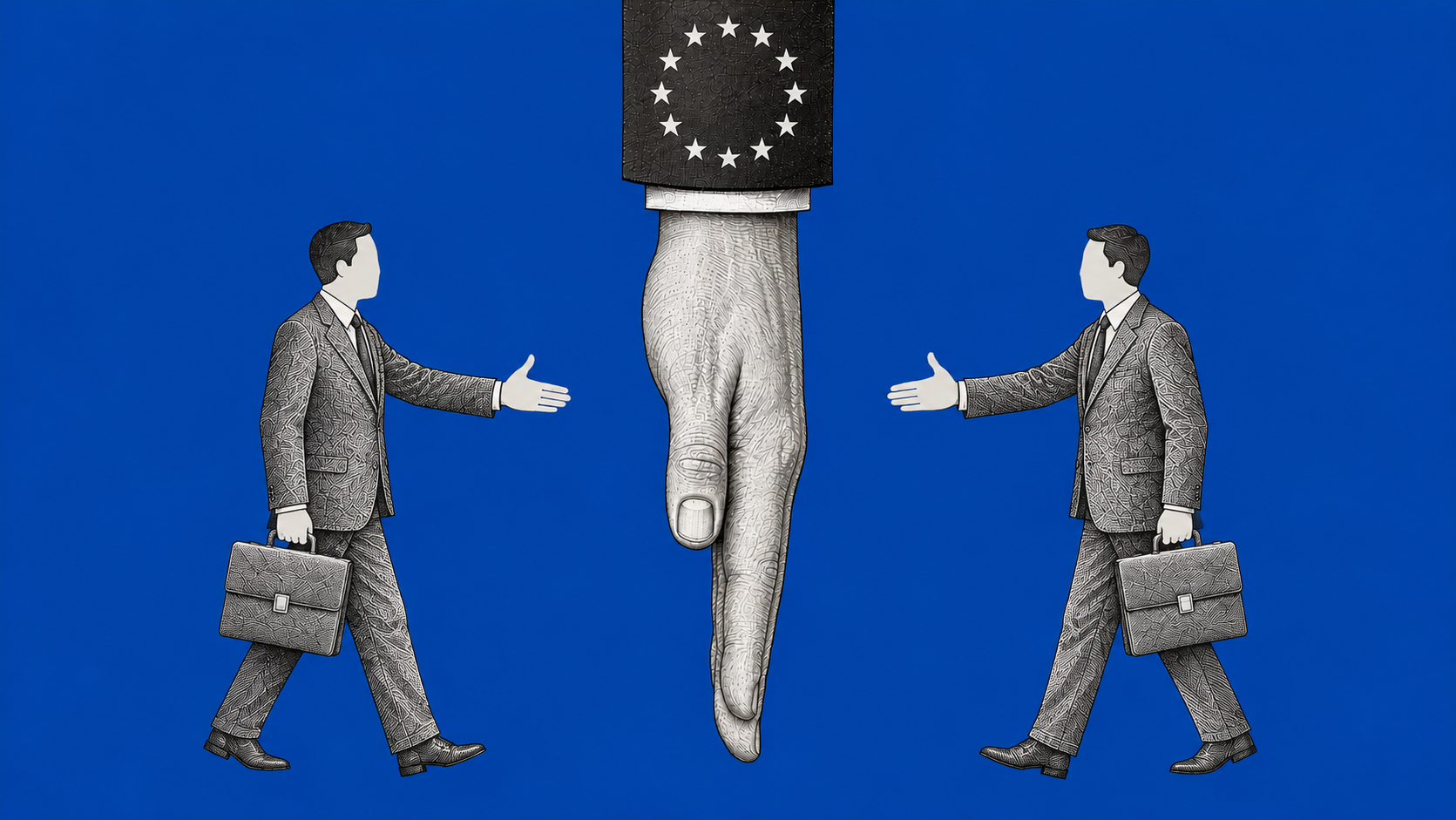
The Austrian School of economics views competition as a process of entrepreneurial discovery and ongoing rivalry, which mergers and acquisitions can help advance. The combination of companies usually enables businesses to pool resources, expand into new markets, and compete effectively against established competitors at a lower cost.
Even under favourable market conditions, the EU deploys excessive regulatory and legal blockages to slow down mergers and prevent market concentration, including the Significant Impediment to Effective Competition (SIEC) Standard, Entrenchment Theory of Harm, and expanded overlapping approvals in an attempt to protect competition and prevent market concentration.
This panoply of obstacles is misguided. The EU should worry less about how large a company becomes and more on whether its regulations prevent new competitors from challenging it. By removing unnecessary barriers to entry and allowing M&A to proceed as freely as possible, Europe can let free market competition, not regulators, determine which businesses succeed or fail.
European regulators cannot reliably predict a merger’s future effects on the market any more than a business owner can predict the success of a new venture. Friedrich Hayek argued that economic knowledge is dispersed among many and cannot be centralised. For example, a merger that initially appears to reduce competition may later generate new efficiencies, products, or even more competition in the future. The European Commission stated that M&A can also ‘result in the creation or strengthening of market power’ while it reviewed the EU Merger Guidelines. Viewing M&A as a threat to competition overlooks how new competitors can emerge in freer markets, since there is no definitive way that officials can know which combinations will succeed or fail. Instead of cementing regulation in uncertain predictions, the EU should keep markets free to correct themselves.
Keeping markets open to new competitors drives innovation, improves product quality, and lowers costs by disciplining existing firms by ensuring the threat of new competition. EU standards do not make entry easy, with regulations based on high capital, infrastructure control, and legal restrictions on top of the classic compliance and licensing procedures that make it harder for new businesses to compete. The SIEC Test monitors an M&A’s potential dominance of a market, for example, and if a buyer is already dominant, the Commission blocks the merger using the Entrenchment Theory of Harm framework. In addition to this, buyers and sellers must also deal with expansion of approvals, which include non-EU and EU merger regulation compliance procedures.
The UniCredit–Commerzbank transaction illustrates how these barriers work in practice. With nearly 50% of shares acquired, the two parties are still negotiating details, but not without political interference from the German government, which opposes the takeover. Too much government concern can result in an unnecessary intervention, such as divestitures, which would require UniCredit to sell certain assets under the guise of protecting competition. This was also used during the EU’s approval of Bayer’s acquisition of Monsanto in 2018, only after Bayer agreed to divest assets in pesticides and agricultural research. The issue is not only whether the government should have a say in cross-border financial transactions, but also whether protecting domestic institutions from foreign acquisition actually helps competition. Political concern does not justify an obstruction of voluntary business combinations, especially when there is no way to know the results of a merger.
Higher concentration in a market does not automatically mean harm to the consumer, and overregulation can become its own barrier to entry. New businesses, including those combined by M&A, can actually bring innovation to challenge present firms to also improve products and services. This was demonstrated by the merging of the Baltic banking operations of Nordea and DNB to form Luminor Bank in 2017. The European Commission cleared the combination of Nordic parent banks with their corporate services in Estonia, Latvia, and Lithuania, forming a major new regional player to challenge the market’s leader, Swedbank. Before the merger, Nordea and DNB each lacked the resources to fund larger projects, but the combination helped both gain the structural scale to compete with dominant players, lower costs, and streamline service framework across three countries.
The joint acquisition of American software company Uplight by France-based Schneider Electric and UK-based Octopus Energy illustrates how mergers can also help companies expand into new markets as new competitors. Since its completion in September, the companies projected $1 billion in savings and incoming new products for customers. The Uplight deal is a great example of potential gains from allowing freer M&A, including higher efficiency and consumer benefits, which could boost market competition over time.
Instead of imposing additional regulations to address the M&A backlog, the EU should remove existing barriers to entry and make cross-border mergers as free as possible. The European tech industry, for example, is plagued by General Data Protection Regulation (GDPR) that requires extensive documentation, liability assessments, and risk classifications that crush the majority of start-ups in earlier stages. Independent studies confirmed a 26.1% drop in European tech venture funding due to GDPR’s early-stage compliance costs. Next, the European Commission should reduce duplicative approvals and harmonise cross-border rules, with extra effort to limit political intervention. The goal is not necessarily to approve every merger (although that’s a a laudable objective), but to avoid obstructing voluntary deals without a sufficient reason and to prioritise free-flowing markets. Markets organically filter out failing mergers through value destruction or bankruptcy, so regulatory intervention is ultimately unnecessary.
—
Instead of focusing on the number of companies in every market, the European Commission should focus on cultivating conditions that allow entrepreneurs to enter, expand, and compete with established firms. Higher integration between markets would allow businesses the freedom to combine resources and compete across national borders. Competition is maintained not by freezing existing transactions, but by clearing the path for new players to challenge them
By the same author


Similar topics


Share to: