How Brussels is fueling the illegal Chinese vape market
Higher EU taxes on legal nicotine products are fuelling demand for illegal Chinese vapes, and the new trade tool proposed by Merz and Macron cannot stop smugglers.
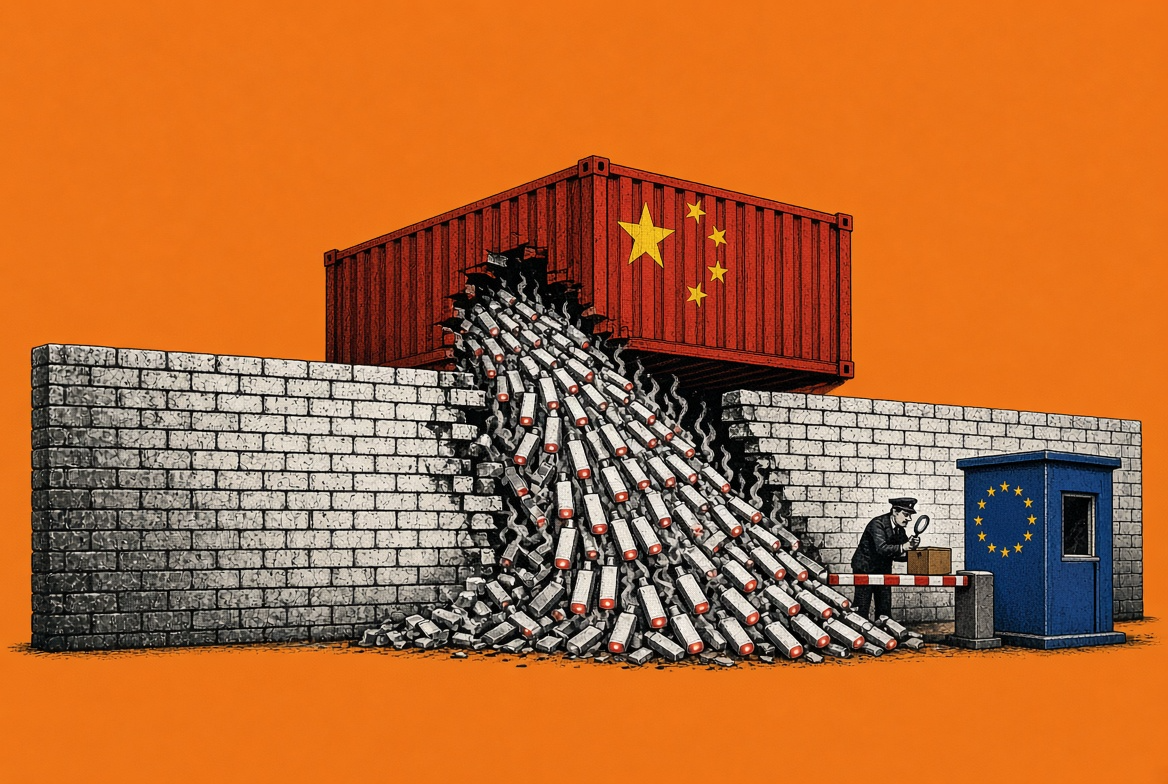
On October 5th, Friedrich Merz and Emmanuel Macron sent Ursula von der Leyen a joint letter with an unusual request, especially coming from Berlin, which in 2024 voted against EU tariffs on Chinese electric vehicles. The two leaders want the European Commission to have an instrument capable of curbing imports, across all sectors, from countries that distort the single market, with measures that could go ‘up to an immediate cut-off from the internal market’, a clear reference to China.
In 2025, the EU imported €559.4 billion worth of goods from China and exported €199.6 billion, a trade deficit of almost €360 billion, up 18% in a single year. Europe depends more and more on what China produces.
In the tobacco and nicotine market, however, dependence on Chinese imports is manufactured in Brussels. Between November 14th and December 15th 2025, the European Anti-Fraud Office (OLAF), the EU agency that investigates fraud and smuggling that harm the EU budget, coordinated JCO VAPE with customs authorities in 30 countries, a joint customs operation against the illegal trade in e-cigarettes and heated tobacco. Inspectors found illegal e-cigarettes from China and Türkiye declared as toys, towels, earphones, clothing and essential oils. Around 90% of the products seized breached health and safety rules.
Brussels justifies its rules on these products on public health grounds. Under Europe's Beating Cancer Plan, the Commission wants fewer than 5% of Europeans to use tobacco by 2040, and it was with this goal in mind that it proposed, in July 2025, a revision of the Tobacco Excise Directive (TED). The proposal, still under negotiation, extends minimum excise duties to e-cigarette liquids, heated tobacco and nicotine pouches. Under the Council's latest proposal, the minimum for cigarettes rises to 60% of the average retail price or €200 per 1,000 cigarettes. For nicotine pouches, it starts at 10% or €30 per kilogram in 2028 and reaches 50% or €80 per kilogram.
Restrictions on tobacco products are spurring illegal imports and producing consequences contrary to their ultimate goal. In France, almost four in ten packs smoked are bought outside the legal market. Belgium became the first EU country to ban disposable vapes in January 2025, and over the course of that year the Belgian federal health service seized more than 140,000 illegal disposable vapes and found them on sale in almost 60% of inspections in Brussels. The largest single seizure of the OLAF operation, 1.7 million e-cigarettes, also took place in Belgium. The ban took the product off legal shelves and handed demand to the black market. Every new tax increase widens the price gap between legal and illegal products in the same way.
Much of that black market is supplied from China. In June, OLAF's Director-General, Petr Klement, said Europe is ‘flooded’ with cheap vapes and faces "large imports" of Chinese vapes. Since 2022, Beijing has banned the sale of flavoured vapes in its own market, yet it only requires exported products to comply with the laws of the destination country. According to the Jamestown Foundation, a Washington-based think tank that has published research on China since the 1980s, there is no public record of the Chinese authorities taking action against exporters that break the rules of destination countries. Chinese manufacturers export what they cannot sell at home, and smugglers bring those products into Europe.
A policy designed to protect public health thus ends up harming it. Among the products OLAF seized were vapes containing cannabis and double the permitted level of nicotine. The legal products the TED wants to tax, from heated tobacco to nicotine pouches, are precisely those that comply with EU rules on composition and labelling.
This is where the Merz-Macron proposal shows its limits. It is not aimed at tobacco, but even if it were applied to Chinese vapes, a market cut-off, a tariff or a quota would only hit those who declare goods at customs and pay the duties. Smugglers do not. The more Brussels taxes the legal product, the more trade shifts to the black market, beyond the reach of the new instrument.
Ursula von der Leyen's Commission is thus caught in a contradiction: it wants to protect European industry from China while proposing higher taxes on tobacco and nicotine, ironically pushing consumers towards illegal Chinese products.
By the same author


Share to: