The State treats us more and more like children
Across Europe, the State corrects the choices of adults, from the price of cigarettes to pension contributions, "for their own good".
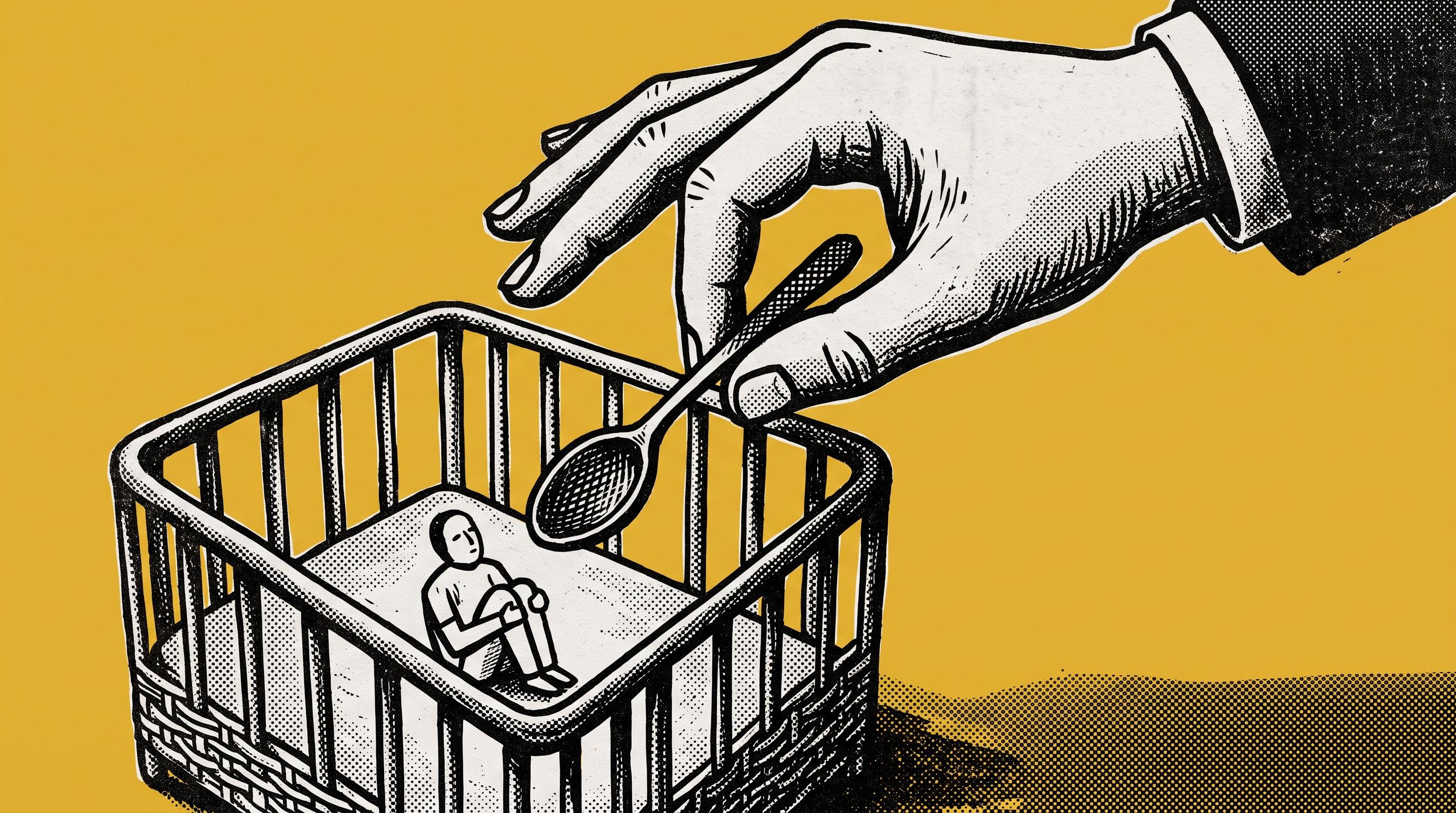
Behavioural taxes [1], restrictions on sales, compulsory pensions, 'nudge' policies, bans in the name of health or safety: across Europe, the State is intervening ever more directly in individual decisions. But some countries go much further than others. Behind these differences lies a fundamental question: how far can public authority claim to protect an adult from himself?
Can an adult be free to make a bad decision? The question seems trivial. Yet it lies at the heart of modern paternalism.
From a libertarian perspective, the individual owns himself. He can be held responsible when he harms others; it is much harder to justify an outside institution constraining him for his own good. Yet this is precisely where the paternalist logic lies: intervening not to prevent aggression, but to correct a choice deemed bad for the person making it.
John Stuart Mill had already drawn this line in On Liberty [2]:
'Over himself, over his own body and mind, the individual is sovereign.'
The contemporary debate is therefore not only about tobacco, alcohol or sugary drinks. More broadly, it concerns savings, pensions, gambling and default decision-making mechanisms.
From information to coercion
Modern paternalism rarely advances all at once. It works in increments.
The State can first inform: health campaigns, warnings, labelling. It can then steer, by arranging the environment so that one choice becomes more likely than another. This is the logic of the nudge, popularised in particular in the United Kingdom, where a government unit specialising in the behavioural sciences was set up as early as 2010.
Then come more directly coercive measures: behavioural taxes, minimum prices, advertising restrictions, limits on sales, regulatory obligations and bans.
The essential boundary therefore lies not between 'intervention' and 'no intervention', but between informing an individual and gradually deciding in his place what is good for him.
Alexis de Tocqueville had already foreseen this development when he described an 'immense and tutelary' power charged with watching over the well-being of citizens, to the point of keeping them 'irrevocably in childhood' [3].
An unevenly paternalistic Europe
European states do not all intervene with the same intensity.
The Nanny State Index 2025, compiled by Christopher Snowdon for the IEA and EPICENTER, compares 29 countries across four areas: alcohol, tobacco, alternative nicotine products and food. Its methodology is explicitly liberal; it is therefore not a neutral public index, but a tool for measuring the extent of the restrictions imposed on consumers.
According to this index [4], Finland scores 37.8 points, Hungary 37.5, Ireland 36.9 and France 26.7. At the other end of the scale, Spain scores 15.9, Czechia 14.5, Italy 13.5 and Germany 11.7.
The differences are stark. Finland and Sweden have a long tradition of regulating alcohol. Hungary makes extensive use of behavioural taxes on certain food products. The Netherlands has considerably tightened its regulation of tobacco and nicotine. France combines high taxation, advertising restrictions and bans.
In France [5], a packet of twenty cigarettes sold for €13.50 in 2026 includes €7.425 in ad valorem excise duty, €1.466 in specific excise duty, €2.25 in VAT and €1.389 in gross margin for the tobacconist, according to the French customs authority. In this example, the manufacturer's margin is only €0.97.
The logic is clear: make a behaviour costly enough to reduce its appeal.
It would be wrong to claim that this does not work. The World Health Organization (WHO) considers [6] raising the price of tobacco to be one of the most effective ways of reducing consumption.
But this is precisely where the libertarian objection begins:
- A constraint does not become legitimate simply because it is effective.
- A total ban would probably reduce consumption even further. That would not automatically make it justified.
Paternalism does not stop at health
It would be a mistake to limit the phenomenon to tobacco or alcohol.
Pensions are another particularly telling example. In many European countries, a large share of income is compulsorily allocated to funding pensions or building up pension entitlements. According to the OECD [7], effective mandatory pension contribution rates for an employee on the average wage reached around 33% in Italy, 28% in Czechia and 27.8% in France [8] in 2022, compared with an OECD average of 18.2%.
The argument is different, but the philosophy remains similar: the individual might not prepare sufficiently for his future, so an institution decides that part of his income cannot be left at his free disposal.
Other countries use more flexible mechanisms, such as automatic enrolment in savings schemes with the option to opt out. The United Kingdom, Italy and Poland have developed this type of system.
The choice remains legally possible, but it is organised so as to produce a specific behaviour.
This is one of the most modern forms of paternalism: no longer banning, but designing the environment so that the individual chooses what the authorities consider preferable.
The circle of socialisation
One of the most powerful arguments for these interventions rests on their collective cost.
A smoker may cost the health system money. A person who does not save enough risks depending on public solidarity. A compulsive gambler may require social care.
But this reasoning creates a particularly interesting circle.
The more the state socialises the consequences of individual choices, the more this socialisation then allows it to justify intervening in those same choices.
If the community pays for your health, your diet becomes its business. If it guarantees your pension, your level of savings becomes its business. If it bears the consequences of your risks, it gradually acquires a reason to regulate your relationship with risk.
The socialisation of costs thus becomes the justification for the socialisation of decisions.
The right to choose badly
The libertarian critique does not claim that all individual decisions are good. On the contrary, it asserts something more demanding: freedom also includes the right to make mistakes.
An adult may choose to smoke despite the risks, to consume too much sugar, to save poorly or to make a reckless decision. As long as he does not violate the rights of others, his bad choice does not, for that reason alone, become the property of the State.
Informing is not coercing. Advising is not banning. Warning is not taxing to discourage.
The question running through Europe today is therefore less a matter of health than of anthropology: do we regard the individual as an adult responsible for his decisions, or as a permanent minor whose choices must be corrected?
The answers still differ from one country to another.
But everywhere, the boundary between protection and guardianship is shifting.
And this is perhaps the real issue at stake in contemporary paternalism: no longer only protecting man from others, but claiming ever more to protect him from himself.
- A behavioural tax (sometimes called a 'corrective tax' or 'Pigouvian tax') is a tax designed to change consumer behaviour by raising the price of products deemed harmful to health or the environment. ↩
- John Stuart Mill, On Liberty, 1859, chapter I. Translated by Charles Dupont-White, Paris, Guillaumin, 1860 ↩
- Alexis de Tocqueville, Democracy in America, volume II, 1840, part four, chapter VI. ↩
- Christopher Snowdon, Nanny State Index 2025, Institute of Economic Affairs and EPICENTER, 15 May 2025. Data as at 1 February 2025. https://iea.org.uk/wp-content/uploads/2025/05/NSI-2025-May-14.pdf ↩
- Direction générale des douanes et droits indirects, 'La fiscalité appliquée aux tabacs manufacturés et la composition du prix de vente au détail', updated 5 January 2026. Packet of twenty cigarettes at €13.50. https://www.douane.gouv.fr/fiche/la-fiscalite-appliquee-aux-tabacs-manufactures-et-la-composition-du-prix-de-vente-au-detail ↩
- World Health Organization, 'Raising taxes on tobacco'. The WHO states that significantly increasing excise taxes and prices is the most effective, and most cost-effective, measure for reducing tobacco use. https://www.who.int/activities/raising-taxes-on-tobacco ↩
- OECD, Pensions at a Glance 2023, 'Mandatory pension contributions'. Effective rates for an employee on the average wage, 2022. https://doi.org/10.1787/678055dd-en ↩
- For Italy and Czechia, these contributions also fund disability benefits. In this table, France's contributions do not. The same applies to Greece, at 26%, which appears in the chart ↩


Share to: