Milei’s record, part two: fiscal surpluses and lower inflation, but reforms remain unfinished
Almost three years on, Milei has a budget surplus and lower inflation, but his most radical promises remain unfulfilled.
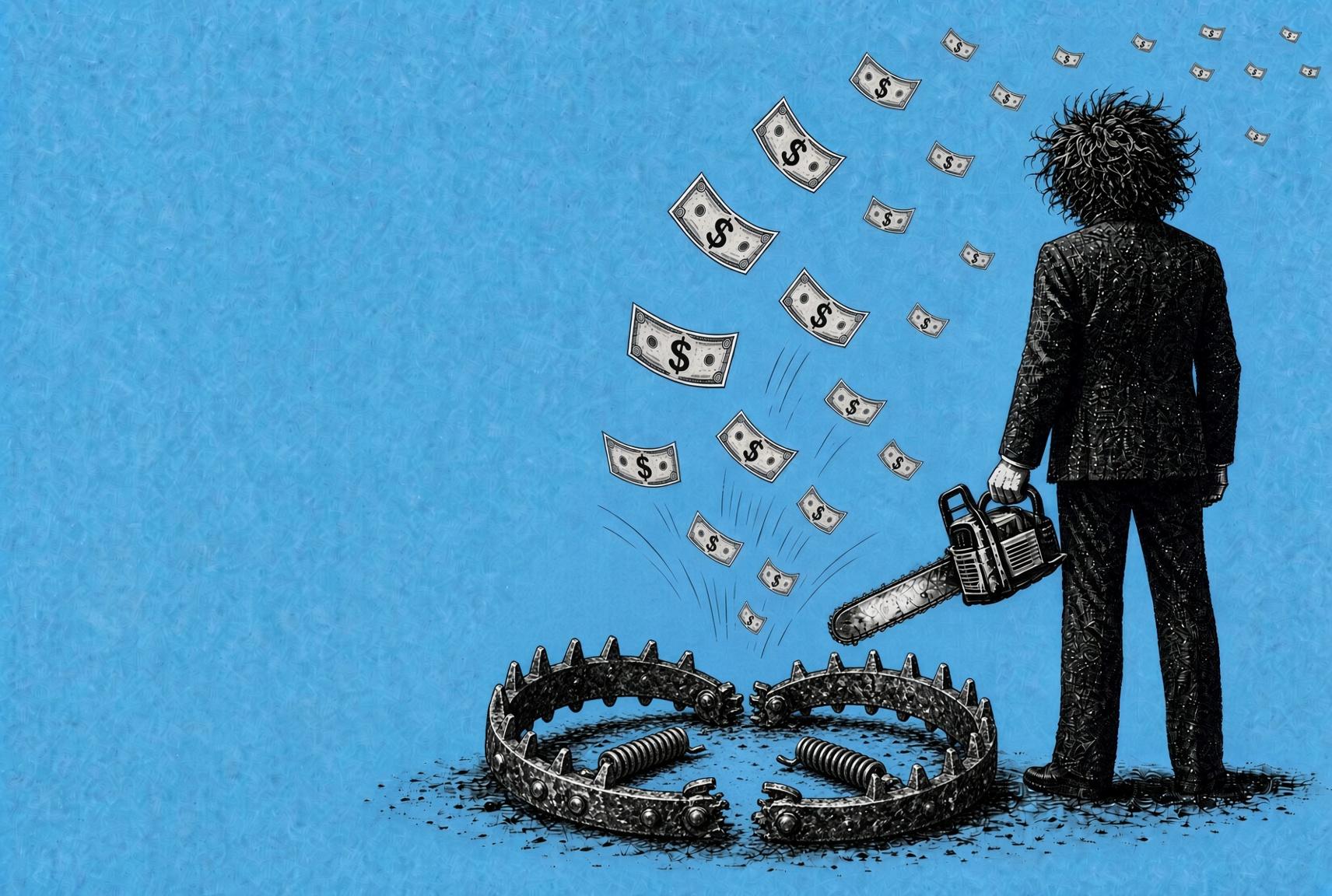
The first part of this article described the Argentina Javier Milei inherited in December 2023: annual inflation above 160%, a central bank with negative net international reserves, a state funded by money creation, and a president with just 38 of the 257 seats in the Chamber of Deputies. This second part examines the measures adopted by the government and their results.
The fiscal adjustment brought the deficit to an end
One of Milei’s first priorities was to cut public spending. On the day he took office, he signed a decree reducing the number of ministries from 18 to nine, rather than the eight he had promised. The national public sector had 341,465 employees in December 2023 and 269,025 in August 2026, a reduction of 72,440 jobs. The steepest fall occurred in the central administration, which includes ministries and secretariats, where employee numbers fell by 32.6% [1].
The cuts went beyond the ministries. In January 2024, for the first time in 12 years, the state collected more than it spent in a single month, including interest payments on its debt. Across 2024 as a whole, the national government recorded a primary surplus, meaning before interest payments, equivalent to 1.8% of GDP, and a surplus of 0.3% after interest payments. It was the first year with a post-interest surplus in 14 years [2].
The cuts fell mainly on public investment and transfers to the provinces. Spending on public works fell by 70% in real terms in 2024, current transfers to the provinces declined by 67.8%, and capital transfers by 96%. Inflation accounted for another part of the savings. Pensions, public-sector salaries and social benefits increased, but by less than prices. In practice, the state spent less on them in real terms, and recipients lost purchasing power. These three spending categories accounted for 40% of the total savings, with pensions alone representing 19% [3].
The government maintained the surplus in 2025, recording a positive primary balance of 1.4% of GDP and an overall surplus of 0.2%. This was the second consecutive year with a surplus after interest payments, something that had not happened since 2008. Public spending stood at around 14.5% of GDP, following a cumulative reduction of 5.3 percentage points of GDP, roughly one-third of the 15 points promised during the campaign [4].
The provinces, however, followed a different path. In 2025, provincial primary spending rose by 8.9% in real terms and, taken together, the provinces moved from surplus to deficit [5].
The central bank stopped financing the government
As the first part showed, the main cause of inflation before Milei was the central bank printing pesos to pay for government spending. As more pesos entered circulation, prices rose. This new money was created in two ways. The first was direct: the central bank lent money to the Treasury and transferred its profits to it. In 2023 alone, up to August, these transfers amounted to around 1.3% of GDP [6].
The second was indirect. To curb inflation, the central bank tried to withdraw some of the pesos it had printed from circulation. It borrowed them from commercial banks and, in return, issued short-term securities known as LELIQ (Liquidity Bills), which paid interest of more than 100% a year. While held by the central bank, these pesos did not circulate in the economy. But the interest still had to be paid, and the central bank paid it by printing more pesos. Each year, the debt and the interest bill grew. In 2023, the last year before Milei, interest payments were the main source of newly created money [7].
In the first week of his term, as described in the first part, Milei’s government devalued the peso from 366 to 800 pesos per dollar, bringing it closer to the parallel-market rate. It then put an end to both.
With a balanced budget, the Treasury no longer needed money from the central bank, which stopped financing it in the first month of his presidency. In July 2024, the central bank also stopped borrowing pesos from commercial banks and transferred that function to the Treasury through securities known as LEFI (Fiscal Liquidity Bills). The difference lies in who pays the interest: the Treasury now pays it with the money left over from the budget, rather than the central bank paying it with newly created money [8].
Inflation fell, but the slowdown lost momentum
Annual inflation fell from 211.4% in 2023 to 117.8% in 2024 and 31.5% in 2025, its lowest level in eight years [9].
The decline, however, lost momentum in 2026. In September, prices rose by 1.9% compared with the previous month and by 33.4% year on year. In the first nine months of the year, monthly inflation fell below 2% only in June and August [10].
Economists point to three reasons. Many prices, such as utility tariffs and rents, are still adjusted in line with past inflation, and wage agreements are generally negotiated on the same basis, which prolongs it. The government has continued to reduce subsidies, and regulated prices, such as energy and transport, rose by 31.5% in the first nine months of 2026, compared with 21.8% for core inflation. Argentines also remain reluctant to hold pesos. The central bank no longer prints money to finance the Treasury, but monetary aggregates are still growing by around 30% a year in nominal terms, roughly in line with inflation. With demand for pesos still weak, even this growth makes it harder for inflation to fall further [11].
Argentina is no longer experiencing triple-digit inflation, but its inflation rate remains far higher than those of its neighbouring countries.
Lifting currency controls and securing external support
Milei initially kept the cepo, the currency controls described in the first part, because the central bank did not have enough reserves to remove them. In April 2025, after securing a $20 billion financing agreement with the International Monetary Fund (IMF), the government lifted restrictions on individuals buying dollars. From April 14th, Argentines were once again free to buy foreign currency, and the peso was allowed to float within a band of 1,000 to 1,400 pesos per dollar [12].
The peso did not collapse when the cepo was lifted. On the first day, the dollar closed at 1,230 pesos, halfway through the band, and in May 2025, the first full month without restrictions, monthly inflation was 1.5%, its lowest level in five years. Argentines bought large amounts of dollars: over the following year, individuals purchased more than $31 billion through official channels. At the same time, the peso appreciated in real terms: the official dollar exchange rate rose by around 12% in a year, while prices increased by 32.6% [13].
The new exchange-rate regime ran into difficulties soon afterwards. In September 2025, Milei’s party lost the Buenos Aires provincial election to the Peronist opposition by a wider margin than expected, and the dollar rose by 4% the following day, reaching a record high. Until the October legislative elections, uncertainty about the future of the exchange-rate regime helped sustain strong demand for dollars among Argentines [14].
In October 2025, the US Treasury agreed a $20 billion currency swap line with Argentina’s central bank, allowing it to obtain dollars in exchange for pesos, to be repaid at a later date. The US Treasury also bought pesos directly on the market, an unusual intervention. President Donald Trump justified the support by citing Milei’s “right philosophy”, but made it conditional on the outcome of the midterm elections: “If he wins, we stay with him. If he doesn’t win, we’re gone” [15]. Argentina drew $2.5 billion from the swap line and repaid the full amount in December 2025. According to US Treasury Secretary Scott Bessent, the operation generated “tens of millions of dollars” for American taxpayers. From January 2026, the central bank began adjusting the limits of the exchange-rate band monthly in line with inflation and buying dollars to strengthen its reserves [16].
Gross international reserves now stand at around $50 billion, and Argentina has not had regular access to international credit markets since 2018 [17]. Investors remain wary. Country risk, the additional interest rate investors demand from Argentina compared with the United States, stood at 1,923 basis points (19.23 percentage points) when Milei took office. It has fallen since then, but has risen again: on October 20th 2026, it briefly reached 710 points, its highest level since October 2025, before closing at 672. Analysts pointed to the political risk surrounding the 2027 presidential election and rising interest rates in the United States [18].
Deregulation advanced faster than privatisation
Ten days after taking office, Milei signed Decree 70/2023, which included 366 economic deregulation measures. Among other changes, it repealed the 2020 rent law, which required three-year contracts with only one rent adjustment a year; the Supply Law, which allowed the state to intervene in prices and profit margins; and rules giving domestic suppliers preference in public procurement. The decree also converted state-owned companies into public limited companies, making them eligible for sale, although, as discussed below, few have actually been sold [19].
In June 2024, Congress approved a scaled-down version of Milei’s major reform package, the Bases Law. It delegated powers to the executive for one year, authorised the privatisation of some state-owned companies and created the RIGI, a regime offering tax, customs and foreign-exchange benefits for 30 years to investments exceeding $200 million [20].
The repeal of the rent law was one of the most visible changes. The supply of rental properties in Greater Buenos Aires rose by 326%, while advertised rents in the capital fell by 32.9% in real terms. The INDEC price index, which measures what tenants actually pay, including under older contracts, shows that rents paid have risen by 683% since December 2023, above overall inflation of 247%. The gap reflects the legacy of the old law. Because rents could be raised only once a year, by an index that lagged inflation, landlords set high starting prices, while rents on existing contracts fell further behind each year. Since the repeal, new contracts have become cheaper, while older ones have been updated towards market levels [21].
The aviation market was also opened to new airlines. In 2025, Argentine airports handled 50.6 million passengers, a record. The state-owned airline, Aerolíneas Argentinas, was removed from the Bases Law’s privatisation list, and the decree declaring it “subject to privatisation” in October 2024 has still not been ratified by Congress. According to the company, it received no Treasury transfers in 2025 for the first time since its renationalisation in 2008, and recorded an operating surplus, before interest and tax, of $112.7 million, after receiving around $7.5 billion from the state between 2008 and 2024 [22].
Privatisation has moved more slowly. The Bases Law authorised the sale of eight state companies, but only a few sales have been completed. In 2026, the government sold its stake in Transener, the electricity transmission company, for around $356 million, and awarded 90% of AySA, the Buenos Aires water and sanitation company, for $340.2 million. The tender for Intercargo, the airport ground-handling company, attracted no bids, and the concession of the Belgrano Cargas freight railway is not expected to be awarded until 2027 [23].
Energy and mining are booming, but foreign investment remains limited
By July 2026, the government had approved 20 projects under the RIGI, representing $46.1 billion in committed investment. The projects were concentrated mainly in mining, oil and natural gas. A further 25 were still under assessment [24].
Foreign direct investment data, however, tell a different story. According to the central bank, net foreign direct investment flows were negative in 2025, partly because companies took advantage of the removal of foreign-exchange restrictions to repatriate capital [25]. Investment commitments announced under the RIGI should therefore not be confused with capital inflows that have already materialised.
Energy production and mining activity reached new highs. In September 2026, Argentina produced 973,700 barrels of oil a day, a historic record, 71% of which came from Vaca Muerta. Between January and August 2026, the energy trade surplus had already exceeded the result for the whole of 2025 [26].
Mining exports reached $6.04 billion in 2025, up 29.2% from 2024, driven mainly by gold and lithium. In agriculture, the government temporarily reduced export duties on soya, wheat and other products in January 2025 [27].
Growth returned, but poverty and wages remain under pressure
After contracting by 1.7% in 2024, the Argentine economy grew by 4.4% in real terms in 2025. Growth was accompanied by a 16.4% increase in investment and a 7.9% rise in private consumption [28].
Poverty followed a less straightforward path. The share of the population below the poverty line fell from 41.7% at the end of 2023 to 28.2% in the second half of 2025, but rose again to 32.3% in the first half of 2026. During this period, the cost of the basic basket of goods rose by 34.7% year on year, while household incomes increased by only 25%. INDEC estimates that around 15.5 million Argentines are now living in poverty [29].
Unemployment stood at 7.8% in the first quarter of 2026 [30].
Wage figures also vary depending on the indicator used. In January 2026, the wages of registered employees were 7.9% below their November 2023 level, according to CEPA calculations based on INDEC data. In the public sector, the fall was 17.9%. Government figures based on social security records, however, indicated that wages in the formal private sector were 3% above their November 2023 level. The difference reflects the sources and methodologies used, so no single figure can be given without specifying the indicator [31].
The opening up to imports has also affected some industrial sectors. The textile, clothing, leather and footwear industries have lost 28,322 formal jobs since December 2023, while clothing imports have increased [32]. These figures show that greater exposure to foreign competition has coincided with job losses in certain sectors, although they do not, on their own, establish that trade liberalisation caused the entire decline.
Road blockades became less frequent
In December 2023, the Ministry of Security approved a protocol allowing security forces to clear streets and roads blocked by demonstrators. In the first half of 2024, the number of street blockades fell by 50% in the city of Buenos Aires and by 22% nationwide, compared with the same period in 2023 [33]. The figures show that these protests became less frequent, but they do not, on their own, establish how much of the change resulted from the new protocol or from other factors.
Greater parliamentary support cleared the way for reforms
Milei’s political position faced fresh challenges in 2025. In February, the president promoted the cryptocurrency $LIBRA, whose price collapsed a few hours after its launch. The case became the subject of a judicial investigation. In August, recordings attributed to the head of the national disability agency revealed allegations of a bribery scheme involving senior officials, including the president’s sister, Karina Milei [34].
The October 2025 legislative elections changed the parliamentary balance. La Libertad Avanza won 40.84% of the vote nationwide. With the support of its allies, the government secured more than one-third of the seats in the Chamber of Deputies, giving it enough votes to prevent presidential vetoes from being overturned [35].
In February 2026, Congress passed a labour reform changing the rules on dismissal compensation, holidays and overtime, while also introducing restrictions on the right to strike. In March, a labour court suspended 81 articles of the law following a legal challenge by the General Confederation of Labour (CGT). In May, a federal court lifted that suspension, but the reform’s constitutionality has yet to be decided [36].
Major progress, with work still ahead
The first part of this article ended with a question: how much of his programme has Milei delivered? In less than three years, a great deal. The government has turned chronic budget deficits into two consecutive years of overall surpluses, ended the Treasury’s direct monetary financing, cut annual inflation from 211.4% in 2023 to 31.5% in 2025 and lifted most foreign-exchange restrictions. Deregulation has transformed sectors such as renting and aviation. Oil production and mining exports have reached record highs, and the president’s party has strengthened its position in Congress.
Some problems persist. Year-on-year inflation edged up again in 2026, poverty rose in the first half of the year and, by some measures, wages remain below their pre-inauguration levels. The provinces have returned to deficit, Argentina still lacks regular access to international credit markets, and net foreign direct investment was negative in 2025. Several privatisations and structural reforms are still pending.
The most radical promises are also yet to be fulfilled: spending cuts have so far reached about one-third of the 15 percentage points of GDP promised, the central bank is still in operation and the peso remains the national currency. The next stage depends on maintaining the budget balance, rebuilding reserves, regaining access to international credit markets and turning investment commitments into completed projects. The 2027 presidential election will show whether Argentines want the programme to continue.
- La Gaceta, ‘Estos son los primeros decretos que firmó Javier Milei como presidente’, 10 December 2023; Diario Panorama, ‘La “motosierra” de Milei ya recortó más de 72.000 empleos públicos’, 1 October 2026 ↩
- Río Negro, ‘Hubo superávit financiero por primera vez en 12 años’, February 2024; Chequeado, ‘El Gobierno nacional logró en 2024 el superávit primario y financiero por primera vez en 14 años’, January 2025 ↩
- BAE Negocios, ‘El 40% del ajuste fiscal fue en jubilaciones, salarios y ayuda social’, 19 January 2025 ↩
- Bloomberg Línea, ‘Histórico: Argentina anuncia segundo año consecutivo de superávit financiero en 2025’, 16 January 2026; IIEP (UBA-CONICET), ‘Reporte de Política Fiscal – Enero 2026’ ↩
- El Cronista, ‘Las provincias aumentaron el gasto y volvieron al déficit’, 26 September 2026 ↩
- Bloomberg Línea, ‘El BCRA volvió a emitir pesos para asistir al Tesoro y le suma combustible a la inflación’, 10 August 2023 ↩
- Ámbito, ‘En 2023, el Banco Central emitió por más de 31 billones de pesos’, 8 January 2024 ↩
- Ámbito, ‘Primer mes de Javier Milei: cuál fue la estrategia del Banco Central’, 10 January 2024; BCRA, ‘El BCRA elimina la emisión endógena generada por los pasivos remunerados’, 11 July 2024 ↩
- Bloomberg Línea, ‘La inflación en Argentina se aceleró en diciembre y cerró el 2024 en 117,8%’, January 2025; Expansión, ‘Argentina registra en 2025 su menor nivel de inflación en ocho años’, 13 January 2026 ↩
- Perfil, ‘La inflación se aceleró al 1,9% en septiembre, según el INDEC’, 13 October 2026 ↩
- Infobae, ‘La inflación en modo “serrucho”: por qué alterna subas y bajas, y cuáles son los factores que complican su desaceleración’, 17 October 2026 ↩
- La Gaceta, ‘Fin del cepo cambiario: cinco puntos clave del nuevo escenario que anunció el Gobierno’, 12 April 2025 ↩
- Diario de Cuyo, ‘La inflación de mayo fue de 1,5%, la más baja en 5 años’, 13 June 2025; El Sol, ‘A un año de la salida del cepo, los argentinos compraron más de 31 mil millones de dólares’, 18 April 2026 ↩
- Diario de Cuyo, ‘El dólar oficial anotó su mayor salto desde abril’, 8 September 2025; Bloomberg Línea, ‘Respaldo de EE.UU. no desalienta demanda de dólares de argentinos antes de las elecciones’, 23 October 2025 ↩
- Noticias NQN, ‘El Tesoro de Estados Unidos compró pesos argentinos y confirmó un swap por US$20.000 millones con el Banco Central’, 9 October 2025; Infobae, ‘Bessent aclaró que no le pidió a la Argentina terminar el swap con China’, 14 October 2025 ↩
- Infobae, ‘La Argentina devolvió los fondos que había recibido por el swap de monedas con el Tesoro de EEUU’, 9 January 2026; BAE Negocios, ‘El BCRA ajustará las bandas por inflación y lanzará un programa de compras de reservas desde enero’, 15 December 2025 ↩
- The Rio Times, ‘Argentina Reserves Top US$50 Billion Again’, 2026; Ámbito, ‘¿Cuándo fue la última vez que la Argentina salió al mercado internacional de deuda?’ ↩
- La Nación, ‘El riesgo país salta hasta los 710 puntos y alcanza el valor más alto en casi un año’, 20 October 2026 ↩
- Palabras del Derecho, ‘El presidente oficializó el decreto de necesidad y urgencia de desregulación económica’, 21 December 2023 ↩
- Buenos Aires Times, ‘Ley de Bases and fiscal package: Senate approves RIGI, privatisations, delegation of powers’, June 2024 ↩
- Chequeado, ‘Alquileres en Argentina: qué pasó con los precios y la oferta después de la derogación de la ley’, 8 October 2026; Cato Institute, ‘Javier Milei Ended Rent Control. Now the Argentine Real Estate Market Is Coming Back to Life’, February 2025 ↩
- A24, ‘Récord histórico en el transporte aéreo: cuántos pasajeros volaron en 2025’, 27 January 2026; Chequeado, ‘Aerolíneas Argentinas informó que tuvo superávit en 2025: 3 datos para entender el tema’, 27 February 2026 ↩
- Infobae, ‘El Gobierno definió la privatización de ocho empresas públicas: cuál es el plan para cada una’, 29 April 2025; BAE Negocios, ‘El Gobierno oficializó la privatización de Transener por USD 356 millones’, 12 May 2026; Ámbito, ‘Tras la venta de AySA, el Gobierno avanza con privatizaciones en trenes y energía’, 10 October 2026 ↩
- El Cronista, ‘RIGI: cuántos proyectos ya están aprobados y qué inversión representan’, 23 July 2026 ↩
- Ámbito, ‘Inversión Extranjera Directa: Gobierno registra un déficit récord de u$s1.700 millones en el año’, 11 July 2025 ↩
- Infobae, ‘La Argentina logró otro récord histórico de producción de petróleo’, 21 October 2026; Infobae, ‘Superávit energético récord: en 8 meses, la Argentina ya superó lo que generó en todo 2025’, 21 September 2026 ↩
- Reporte Minero, ‘Exportaciones mineras de Argentina: récord en 2025’, 16 January 2026; La Nación, ‘El Gobierno decidió bajar las retenciones al campo de manera temporal’, 23 January 2025 ↩
- Chequeado, ‘El PBI cayó un 1,7% en 2024’, 19 March 2025; Ámbito, ‘El PBI creció 4,4% en 2025, pero registró su segunda desaceleración trimestral consecutiva’, 20 March 2026 ↩
- Infobae, ‘La pobreza subió al 32,3% en el primer semestre del año y afectó a 15,5 millones de personas’, 24 September 2026 ↩
- Ámbito, ‘El desempleo mostró una leve baja al 7,8% en el primer trimestre, pero se mantuvo cerca de máximos de 2021’ ↩
- El Observador, ‘El salario registrado cae por sexto mes consecutivo contra la inflación y está 8% por debajo de noviembre 2023’, 26 March 2026; La Nación, ‘Los salarios registrados cayeron en marzo, pero un dato oficial dice que están 3% por arriba de noviembre de 2023’, 14 May 2026 ↩
- Pausa, ‘La industria textil profundiza su caída: produjo 22,6% menos y perdió más de 28.000 empleos’, 4 October 2026 ↩
- El Trece, ‘Patricia Bullrich anunció el protocolo antipiquetes: los puntos salientes’, 14 December 2023; La Nación, ‘Repliegue piquetero: los cortes de calle en CABA se redujeron un 50% respecto al año pasado y un 22% en todo el país’, 22 July 2024 ↩
- El Economista, ‘Revés judicial para Javier Milei: un fiscal comenzó a investigarlo por estafa y tráfico de influencias’, February 2025; El Cronista, ‘Corrupción en ANDIS: Spagnuolo declaró en la causa por defraudación al Estado’ ↩
- Todo Jujuy, ‘La Libertad Avanza se impuso con el 40,84% en las elecciones 2025’; La Política Online, ‘Amplio triunfo de Milei: ganó con el 40% y se asegura el tercio para blindar los vetos’, 26 October 2025 ↩
- Diario Sindical, ‘Reforma laboral: la Justicia federal suspendió la cautelar de la CGT, pero resta la sentencia definitiva’, 8 May 2026 ↩
By the same author


Similar topics


Share to:
By the same author
Similar topics