Vandals are neither victims nor automatons
Those who justify vandalizing in the name of social determinism commit an intellectual error.
There are intellectual fashions that are as dangerous as they are incoherent. Among them, the tendency to glorify urban violence under the guise of social subversion occupies a prominent place.
Following the violence of October 17th (between 550,000 and 800,000 protesters, 2,397 arrests that day and 997 police officers and gendarmes injured), the Solidaires Étudiant·e·s union published the following statement: ‘Violence is merely a legitimate response to the systemic violence of a racist state. [...] We have no need to comply with the bourgeois injunction to condemn vandalism.’
As far back as the 2005 riots in France, some intellectuals and philosophy professors, such as Serge Roure in his essay Apologie du casseur, thought it appropriate to defend the rioters in the name of an allegedly unjust social order. In this book, the author invokes Spinoza and Schopenhauer to support his rejection of free will. He argues that ‘if we were in a rioter's position, we would probably behave in the same way’. In his view, ‘social violence is produced by a violent social environment’. Yet, on closer examination, this approach has less to do with genuine philosophical rigour than with armchair determinism.
The fallacy of determinism
The central argument put forward by apologists for violence rests on a sociological assumption: the individual is nothing more than the product of his environment. Following in the footsteps of Marx's historical materialism, Pierre Bourdieu developed one of the most influential theoretical frameworks for social determinism in France. His arguments are now echoed by those who want to do away with the idea of meritocracy and individual responsibility.
If the environment is violent, unequal or oppressive (capitalism, racism or power), the individual's violent behaviour supposedly becomes inevitable and therefore excusable. According to this way of thinking, the rioter is merely a victim acted upon by forces beyond his control.
Yet the contradiction inherent in this position becomes glaringly obvious as soon as we examine it without indulgence. The determinist displays remarkable hypocrisy by applying determinism selectively:
- On the one hand, he denies individual responsibility to criminals and rioters, turning human beings into mere objects manipulated by social structures.
- On the other, he attributes complete, conscious and almost diabolical moral responsibility to the "villains" in his narrative (business owners, police officers, the bourgeois state and its judges).
The solution proposed by these theorists is therefore a pure utopia: to transform society as a whole, eliminate every temptation and purify the environment so that no individual can ever do wrong. Such a project, besides being impossible to achieve, would turn the world into one vast bureaucratic prison.
The self-contradiction of determinism
Determinism is also an epistemological absurdity. Marxist historical materialism and sociological determinism undermine the very rationality of those who advocate them.
According to Roy Childs, an American essayist and columnist:
‘Strictly speaking, determinism is self-contradictory. If human thought, and reason above all, is subject to strict environmental and biological determinism, then any distinction between truth and error becomes impossible. The mind has no means of verifying whether its conclusions are logical or merely the conditioned product of a mechanism that compels it to regard as rational something that is not.’
At the heart of this argument lies the distinction between cause and reason. A physical cause (neurological or environmental) has no truth value; only a logical reason can have one. If our thoughts have causes rather than reasons, they cannot be either true or false. They are simply things we undergo.
Therefore, if we take determinism to its logical conclusion, those who uphold law and order are also determined by their environment. Why, then, condemn them so vehemently on moral grounds?
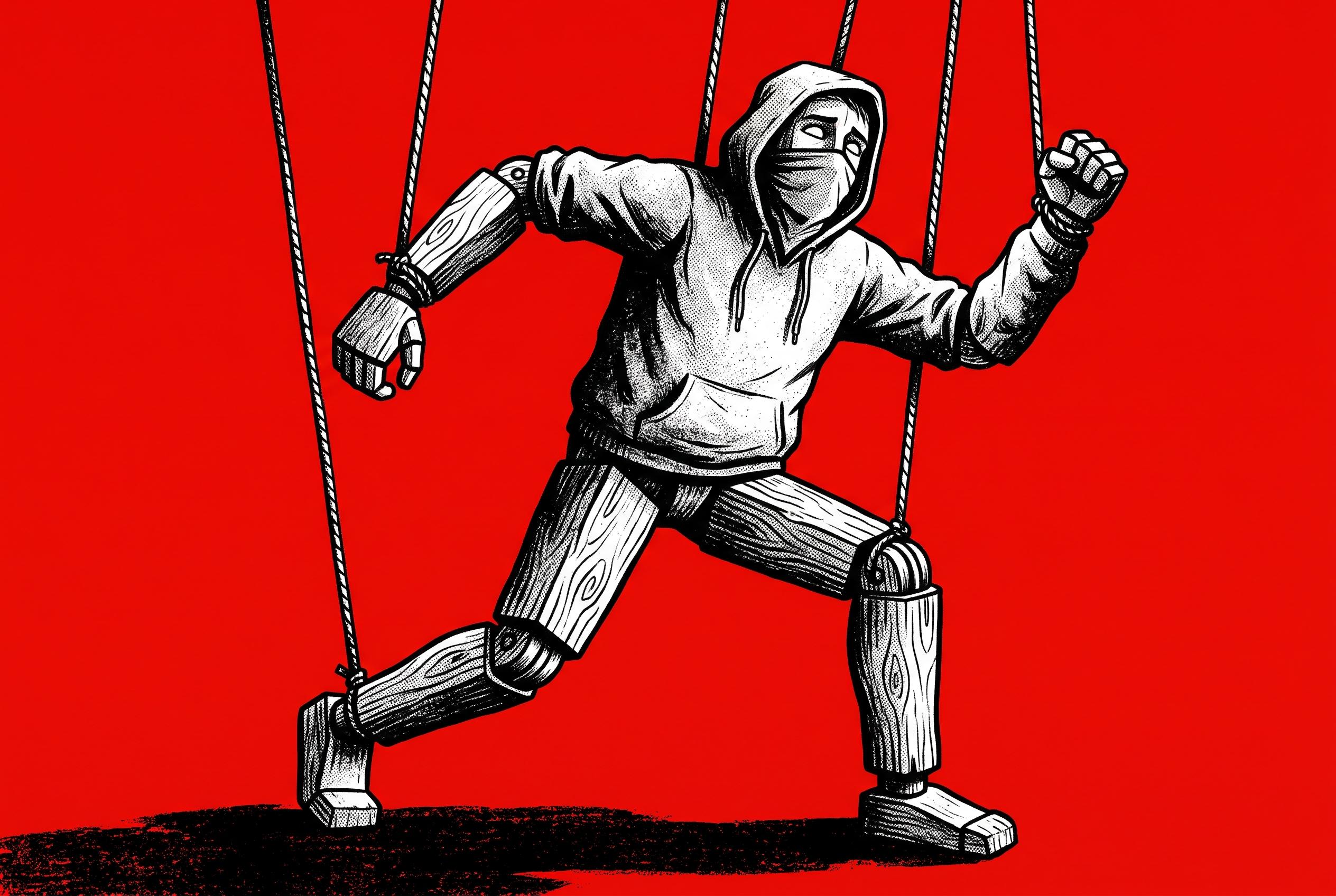
Individual will versus the mechanical puppet
To understand the flaw in determinism, imagine choosing a dish at a restaurant. Your choice does not arise independently of reality: your budget, hunger, personal history and tastes all shape your decision. Yet nobody is holding a gun to your head. You act without external coercion. Freedom does not mean the absence of causes, but rather the ability to act according to your own will and reasons.
The economist and philosopher Ludwig von Mises takes this argument further: human beings are not mere puppets governed by sensory impulses. They have the power to restrain their instinctive desires and make choices. Far from ignoring the constraints of heredity or environment, Mises draws a fundamental distinction that crude determinists overlook:
‘Man is not, like animals, a puppet at the mercy of instincts and sensory impulses. Man has the power to restrain his instinctive desires, he has a will of his own, and he chooses between incompatible ends. It is in this sense that he is a moral person; it is in this sense that he is free.’
For Mises, the individual is indeed, at every moment, the product of the entire history of the universe, his inherited physiological make-up and his experiences. An omniscient being could theoretically predict his choices.
But this does not make man a merely passive object or an irresponsible automaton. He retains a will of his own and the ability to choose between different ends. Reducing a rioter to a mere mechanical reaction to his social environment is precisely to reduce him to the status of a puppet and deny him the dignity of a moral person capable of making decisions about his own actions.
Freedom and causality are not enemies
Invoking the great thinkers of determinism to justify the glorification of vandalism is a philosophical misinterpretation.
For Spinoza, freedom and consciousness do not mean smashing everything on the grounds that we are determined. On the contrary, they involve understanding necessity through reason. For the Dutch philosopher, a free man is one who manages to transform his passive passions and blind reactions into rational actions. The Spinozist sage does not destroy republican symbols or schools in a fit of anger; he rises above such impulses through knowledge. To reduce Spinoza to an advocate of brute violence is to overlook the fact that his philosophy calls for self-examination as a means of freeing ourselves from the bondage of the passions.
In Schopenhauer's philosophy, consciousness and lucidity lead even less towards rioting. For the author of The World as Will and Representation, the observable world is a theatre of universal suffering. But access to a form of liberation does not come through destruction and violent political demands, which merely intensify the endless cycle of the will to live and suffering. Instead, it comes through compassion, aesthetic contemplation or asceticism. To praise the rioter is to celebrate the triumph of the most blind and selfish Will, precisely the opposite of what Schopenhauerian wisdom advocates.
Rediscovering the complexity of human action
Praising vandals amounts to a double failure. Intellectually, it means manipulating a dogmatic form of determinism that collapses under scrutiny. Ethically and politically, it means encouraging blind destruction and a culture of excuse-making under the pretence of defending justice.
True freedom, whether understood as the exercise of moral will in the face of external influences (Mises), the expansion of one's capacity to act through reason (Spinoza), or lucidity in the face of the traps of desire (Schopenhauer), requires us to move beyond the simplistic assumptions of immature Marxism and the denial of personal responsibility. Recognising that individuals possess a degree of autonomy and moral responsibility is precisely what it means to respect them as human beings, rather than reducing them to mere statistical products to be instrumentalised in a political op-ed.
- For an accessible introduction, see François Bégaudeau’s videos, in particular this one. ↩
- On this point, see Friedrich Hayek, The Road to Serfdom. ↩
- Roy Childs, Liberty Against Power, Fox & Wilkes, 1994. ↩
- Ludwig von Mises, The Ultimate Foundation of Economic Science (1962), chapter 3, section 4, ‘Free will’. The French edition is published by the Institut Coppet and is available as a free PDF. ↩
- See the very end of Spinoza’s Ethics: the Scholium to Proposition 42 of Part V. ↩
- A concept of Schopenhauer’s referring to the universal desire for self-preservation. ↩
- To see how Schopenhauer moves from a lucid analysis of the world to true freedom, see Book IV, in particular §68 and §71. ↩
By the same author


Share to: